Wear red to school
Home Wear Red for Dyslexia Awareness
Wear red.
OCTOBER 2026 · DYSLEXIA AWARENESS MONTH
Wear red.
Every learner belongs.
Join Cannon Cubs on Thursday, October 8, 15, 22, and 29. Four days to show our support for students with dyslexia.
See the dates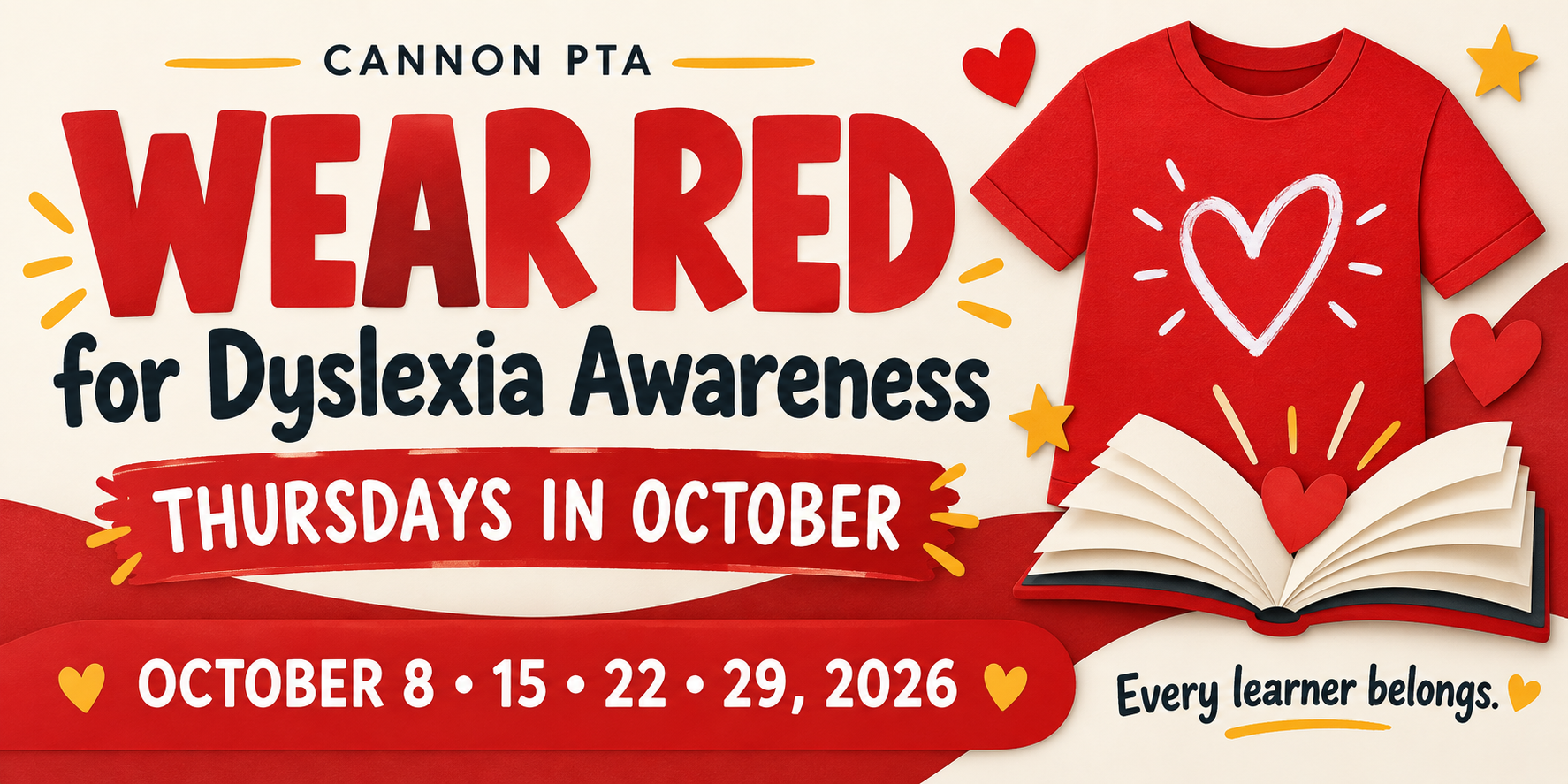
FOUR THURSDAYS. ONE CARING COMMUNITY.
A little red. A lot of support.
Cannon Cubs, wear red on October 8, 15, 22, and 29 to recognize Dyslexia Awareness Month. Together, we can help every learner feel seen, supported, and included.
Mark your October Thursdays.
Wear red to school
Wear red to school
Wear red to school
October 8 is also Picture Day and Early Release.
HOW TO JOIN IN
Wear red. Share kindness.
- Choose something red.
A shirt, socks, or an accessory you already have is a simple way to participate.
- Encourage every learner.
Celebrate effort, practice patience, and remind our Cubs that everyone belongs.
- Learn together.
Explore the family resources below and start a conversation about supporting different learning needs.
GET TO KNOW DYSLEXIA
What is dyslexia?
Dyslexia is a specific learning disability that makes reading words accurately or quickly, spelling, or both more difficult. It can look different from one learner to another and can also affect reading comprehension and written work.
Many learners with dyslexia find it hard to connect speech sounds with letters and word patterns. These challenges are unrelated to overall intelligence. A child can have strong ideas, curiosity, and understanding while finding reading and spelling difficult.
Early support matters, and targeted instruction can help at any age. Dyslexia is lifelong, but learners can make meaningful progress with appropriate teaching and support.
Sources: International Dyslexia Association: 2025 definition · Yale: What is dyslexia?
A CLOSER LOOK AT READING
When reading takes extra effort.
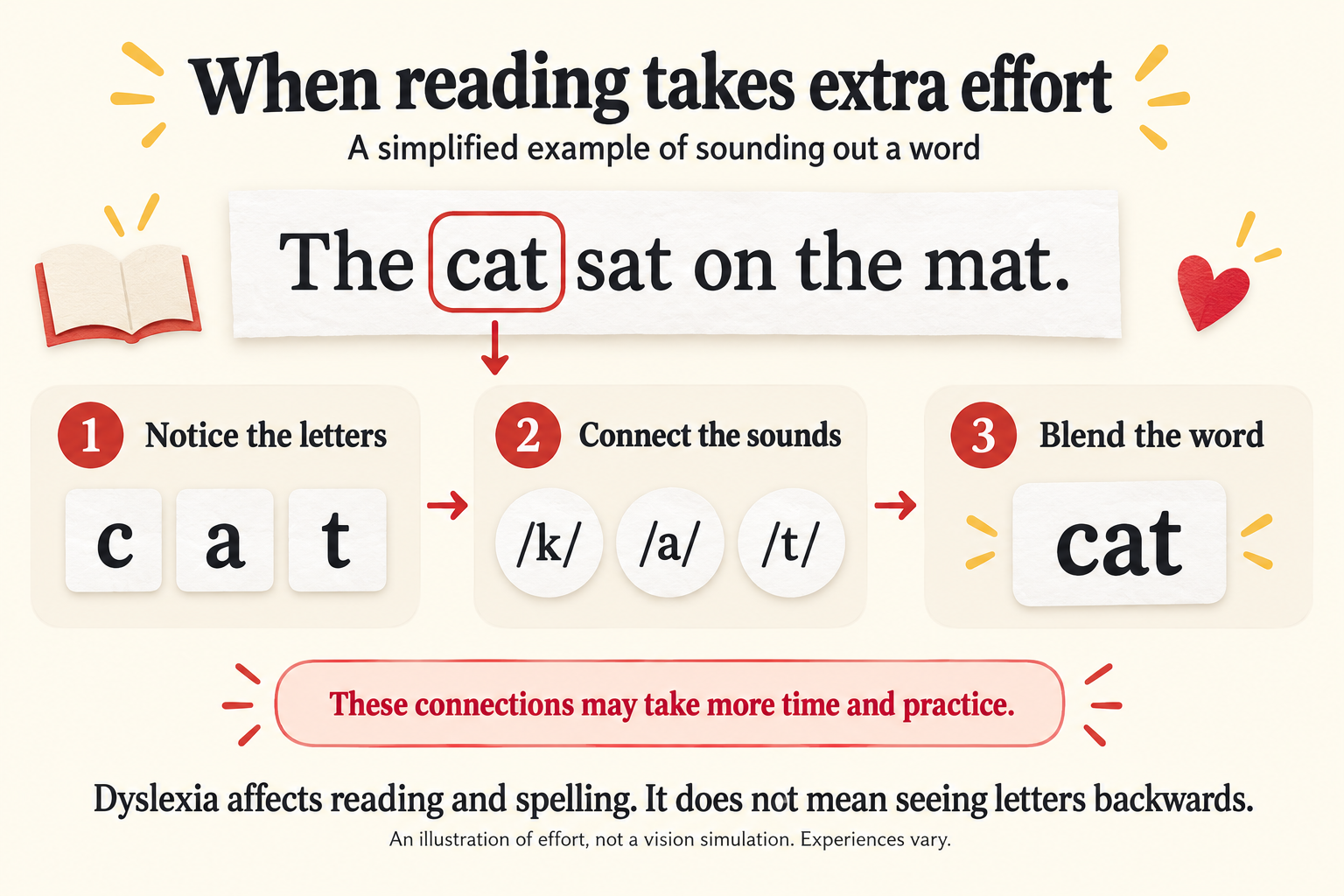
A familiar word may feel automatic to one reader. For another, connecting letters with sounds and blending them into a word can take more time and effort.
Read the graphic in text
The sentence is “The cat sat on the mat.” The example focuses on the word “cat.”
- Notice the letters: c, a, t.
- Connect the sounds: the sound of c, the short a sound, and the sound of t.
- Blend the word: cat.
These connections may take more time and practice. Dyslexia affects reading and spelling; it does not mean seeing letters backwards.
Try a short decoding activity
This made-up code illustrates the effort of decoding unfamiliar print. It is not a simulation of how dyslexia looks or feels, and it is not a test for dyslexia. Everyone’s experience is different.
Use the key to read the sentence at your own pace. You can reveal the answer whenever you like.
1 = a2 = e3 = i4 = o5 = u
W2 c1n l21rn 3n d3ff2r2nt w1ys 1nd st3ll d4 gr21t th3ngs.
Reveal the sentence
We can learn in different ways and still do great things.
Pause and reflect: Did looking up the code interrupt your understanding? How might extra time, patient encouragement, or hearing the sentence help? This activity is a conversation starter about effort—not a way to reproduce someone else’s disability.
Signs families may notice.
Look for patterns over time and across activities. Signs vary with age, instruction, and the child’s language background.
Preschool
- Difficulty recognizing or making rhymes.
- Trouble learning letter names.
- Delayed speech or persistent difficulty pronouncing familiar words.
Kindergarten & grade 1
- Difficulty connecting letters with sounds.
- Trouble blending sounds into simple words.
- Guessing words instead of sounding them out, or avoiding reading.
Grades 2–5 & beyond
- Slow, effortful reading, especially of unfamiliar words.
- Persistent spelling difficulties.
- Reluctance to read aloud, even when understanding spoken information well.
A family history of reading or spelling difficulties is also useful information to share. Letter reversals alone do not identify dyslexia, and a child does not need to show every sign to need support.
These are conversation starters, not a diagnosis. Ask about persistent difficulties early; there is no need to wait for a child to fail before raising concerns.
Source: Yale Center for Dyslexia & Creativity: Signs of dyslexia
A few facts worth sharing.
Ability goes beyond reading.
Dyslexia does not reflect a person’s intelligence. Every child has their own interests, strengths, and learning needs.
It is not “seeing backwards.”
Letter reversals alone do not identify dyslexia. Young children with and without dyslexia may reverse letters while learning to write.
Support can make a difference.
Children do not simply outgrow dyslexia. Effective instruction can help them develop reading skills and strategies.
Source: Yale: Dyslexia FAQ
What helps students?
Clear, systematic reading instruction. Structured Literacy teaches language and reading skills directly, in a planned sequence. It connects speech sounds, letters, syllables, word parts, spelling, vocabulary, and meaning, with practice and feedback tailored to the learner.
Encouragement and access to stories. Read aloud together and talk about characters, ideas, and new words. This helps build language comprehension while your child works on reading skills. Celebrate progress and make space for interests they enjoy.
Sources: International Dyslexia Association — Structured Literacy · Reading aloud with your child
SCREENING & EVALUATION
How do we find out what a child needs?
A screening identifies possible risk.
A brief screening checks early reading skills and flags students who may need closer attention or extra instruction. It does not diagnose dyslexia. Texas requires dyslexia screening at the end of kindergarten and by January 31 in grade 1. Families can ask for help at any age, including after an earlier screening showed no concerns.
An evaluation looks at the whole learning picture.
A qualified evaluator combines family and teacher input, learning history, instruction and progress, and individual assessments. Depending on the child’s needs, these may examine word reading, reading speed and accuracy, sounding out unfamiliar words, spelling, speech-sound awareness, and language skills. One online quiz cannot provide this picture.
Ask for a written explanation of the findings, the child’s strengths and needs, and recommended instruction and supports. An evaluation should consider all suspected areas of difficulty, including writing when relevant.
Sources: IDA: Testing and evaluation · TEA: 2026–27 screening requirements
Requesting a school evaluation in Texas
Parents can request an evaluation at any time. Send a written request to the district’s special education director or a district administrative employee and keep a copy. Describe your concerns and ask about a full individual and initial evaluation for suspected learning disabilities.
For a written request delivered to one of those district staff members, the district generally has 15 school days to propose an evaluation or provide written notice explaining a refusal. After written parental consent, the evaluation generally must be completed within 45 school days; absences and end-of-year rules can affect the timeline. The school should explain the deadlines that apply to your child.
Support for reading can continue while an evaluation is considered or completed. Ask how progress will be monitored and how results will guide next steps.
Sources: TEA: Evaluation and parent rights · GCISD: Section 504 & Child Find
UNDERSTANDING BUILDS SUPPORT
Resources for families.
Explore these resources for more information about dyslexia, instruction, and supporting your child.
LOCAL SUPPORT
GCISD Dyslexia Information ↗
District information and resources for parents and educators.
FAMILY GUIDE
What Every Family Should Know ↗
A handbook from the International Dyslexia Association.
Help spread the word.
Save the graphic and keep these four Thursdays handy.
THERE’S A PLACE FOR YOU